TIMETABLE
08:00 Antoni Rayzhekov: Sixteen_rivers
08:25 John Fireman: HELD
08:50 Tan Bone: UNHEARed TERRITORY
9:10 Cecilia Morales: Mutable Cartography
10:00 Antoni Rayzhekov: Sixteen_rivers
10:25 John Fireman: HELD
10:50 Tan Bone: UNHEARed TERRITORY
11:10 Cecilia Morales: Mutable Cartography
12:00 Antoni Rayzhekov: Sixteen_rivers
12:25 John Fireman: HELD
12:50 Tan Bone: UNHEARed TERRITORY
13:10 Cecilia Morales: Mutable Cartography
14:00 Antoni Rayzhekov: Sixteen_rivers
14:25 John Fireman: HELD
14:50 Tan Bone: UNHEARed TERRITORY
15:10 Cecilia Morales: Mutable Cartography
16:00 Antoni Rayzhekov: Sixteen_rivers
16:25 John Fireman: HELD
16:50 Tan Bone: UNHEARed TERRITORY
17:10 Cecilia Morales: Mutable Cartography
18:00 Antoni Rayzhekov: Sixteen_rivers
18:25 John Fireman: HELD
18:50 Tan Bone: UNHEARed TERRITORY
19:10 Cecilia Morales: Mutable Cartography
Klanginstallationen von:
- Antoni Rayzhekov: Sixteen_rivers
- John Fireman: Held
- Tan Bone: UNHEARed TERRITORY
- Cecilia Morales: Mutable Cartography
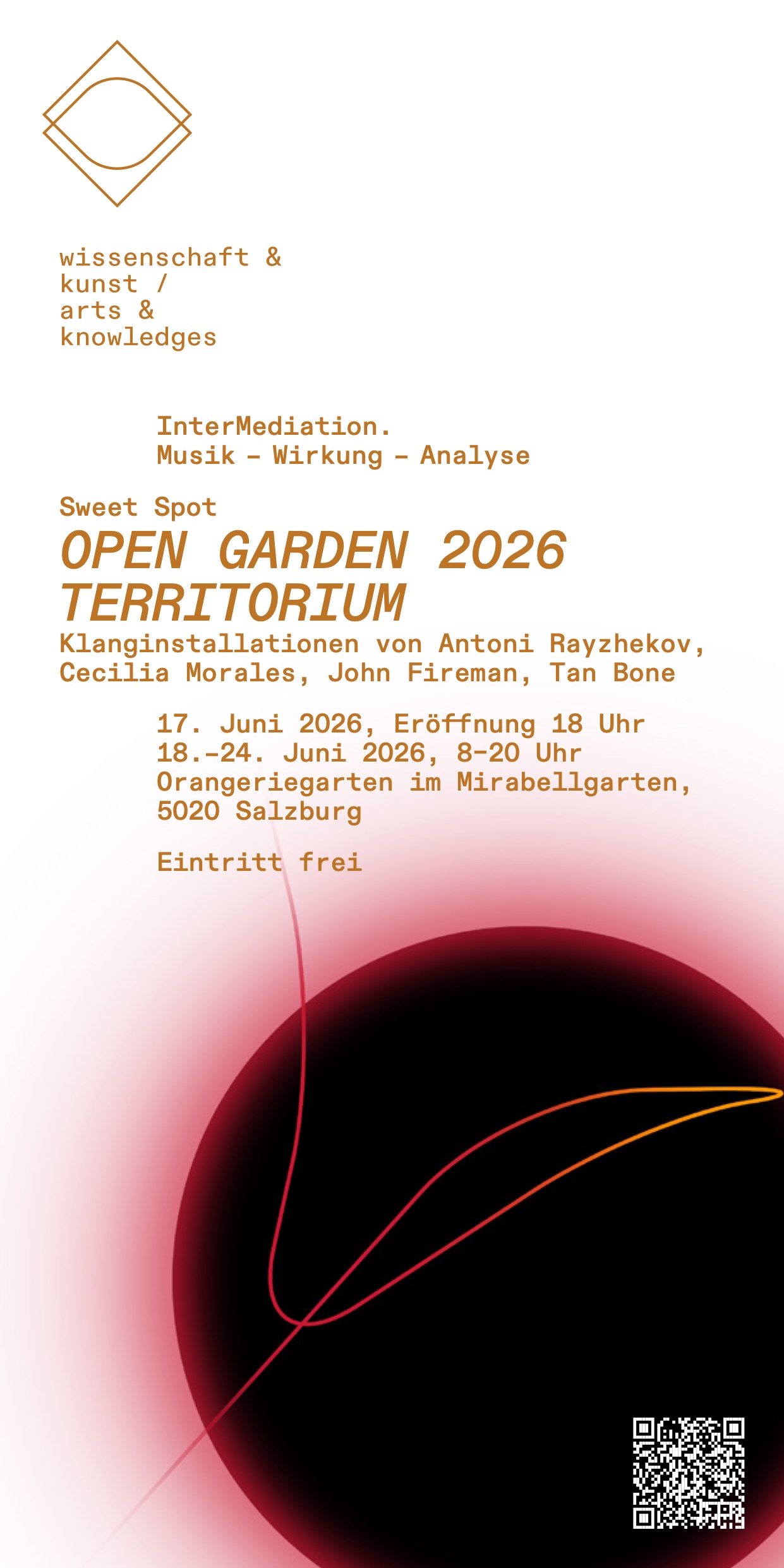
18.-24. Juni 2026, 8:00-20:00
Eröffnung: 17. Juni 2026, 18:00
Orangeriegarten im Mirabellgarten, Mirabellplatz, 5020 Salzburg
Information: InterMediation@plus.ac.at | +43 662 8044 2380
SIXTEEN_RIVERS
16-channel sound installation
Sixteen_rivers extracts the geographic curves of the Salzach and fifteen rivers connected to it through the Danube watershed: Inn, Isar, Enns, Traun, Drau, Mur, Raab, Dyje, Vah, Hron, Sava, Kupa, Bosna, Morava, and the Danube itself, a hydrological network crossing multiple countries. The vector data of each river is converted into an audio waveform, and its length becomes a measure of time. Fifteen tuned strings are excited by the geographic curves of their rivers: the waveform strikes the string, and the river’s terrain shapes both the attack and the damping.
Each river’s curve is read also as a micro-score: at regular intervals determined by the river’s length, the current position along the curve selects a pitch from a just-intonation scale. Short mountain tributaries step rapidly, producing quick, restless phrases; longer lowland rivers step slowly, unfolding in broad, sustained arcs. The same curve simultaneously governs amplitude, spectral brightness, vibrato, and the string’s resonance. The Danube, the longest, is not plucked but sustained and its geography reed as a single slow breath across the entire duration. All sixteen voices share a common fundamental. Sound flows between speakers through frequency modulation following the hydrological connections, tributaries converging, currents merging, one river’s voice carrying into the next. In the final minutes, the rivers fade out one by one, shortest first, until only the Danube remains.
The listener walks through overlapping sonic territories shaped by the same forces that shaped the continent’s political geography, water that was never asked where it wanted to go.
______________________________________________________________________________
Antoni Rayzhekov is an interdisciplinary artist and educator based in Salzburg, working across sound installation, electroacoustic performance, and instrument building. Trained in theatre directing and performing (National Academy for Theatre and Film Arts, Sofia), jazz piano (Vienna Konservatorium), and computer science (LearningTree, London).
Since 2004 he has been developing performative instruments and generative compositions in which the artistic concept determines the technology, the technology shapes the material, and the material defines the interaction. Objects, bodies, landscapes, and data serve as compositional input, where their physical properties translated into sound through custom-built hardware, computer vision, and software in Python, SuperCollider or VVVV. By embedding artistic intent directly into the technological system, he seeks to uncover hidden processes and entanglements, letting the artwork unfold “here and now”.
Antoni Rayzhekov is a research fellow at the Human-Computer Interaction Center, University of Salzburg, and a guest lecturer in Sound Art at the National Academy of Arts, Sofia. He co-founded the DALAB Foundation and consults the DA Fest biennial for digital arts. Previous fellowships include Akademie Schloss Solitude (2016–17), a WimmelResearch residency at the Bosch Research Center (2018), and S.T.E.I.M. Amsterdam (2013). His work has been presented internationally at venues including MANIFESTA’14, CAPC Museum of Contemporary Art Bordeaux, Museum of Contemporary Art of Vojvodina in Novi Sad, the World Expo Shanghai, among many others.
See more: rayzhekov.com
HELD
16-channel sound installation for Sweet Spot, Open Garden 2026: Territorium
An Impulse Response (IR) is the acoustic trace of a real-world space, its resonant character made audible. But the trace alone gives only decay, reflection, size; the rest, such as „the rust of the empty factory,“ or the felt absence of those who worked there… is supplied by the listener. Meaning is projected.
Territory works the same way. A place becomes a place only when someone draws a line around it and calls it one. The piece makes that constitutive act audible by sound material whose meaning depends on the listener’s willingness to imagine themselves “inside it.”
______________________________________________________________________________
John FIREMAN, Composer, Sound & Video artist
John Fireman has an MBA in entertainment media and technology from New York University and a BFA in film theory from Yale University. He currently is Visiting Assistant Professor of Visual Arts (Video + Sound Art) at Bowdoin College —Brunswick, Maine (US).
John Fireman’s focus is feature-length, experimental documentary films. He also works in video, sound, multimedia installation, photography, electroacoustic music composition, and performance.
Selected Exhibitions & Festivals
Jan – May 2027 Solo Exhibition (forthcoming), Center for Maine Contemporary Art (CMCA), Rockland, ME
2026 Experimental Sound Practices, California Institute of the Arts (CalArts), Valencia, CA
2025 MA/IN Festival — Acousmatic & Audiovisual Selections, ArteScienza / Goethe-Institut, Rome, Italy
2025 Mixtur Festival, Barcelona, Spain
2024 Ars Electronica / Forum Wallis, Leuk, Switzerland
2024 Napoleon Electronic Arts Festival, Eastern Illinois University, Charleston, IL
2020 Acoustic Resonance, Institute of Contemporary Art at Maine College of Art, Portland, ME
Curatorial & Other
Ongoing Open Systems — Founder & Curator. Artist-run nonprofit multichannel performance space dedicated to experimental electronic music
See more: john-fireman.com
UNHEARed TERRITORY (2024/2026)
Klanginstallation, 10:52
Aufnahmen aus Flüchtlingslagern von
Nang Seng Mai (Kachin)
Ro Maung Hla Myint Arafat (Cox’s Bazar, Bangladesh)
Joycy Muani (Mizoram, India)
Inhalt der Aufnahmen
Grenzzaun zwischen Kachin (Myanmar) und China. In der Nähe eines Flusses, wo sich ein Lager für Binnenvertriebene befindet. Lautsprecher warnen die Menschen ständig davor, dem Zaun zu nahe zu kommen
Karate-Unterricht in Kachin, Myanmar
Spielende Kinder in Mizoram, Indien
Die Rohingya-Gemeinschaft fordert Sicherheit und Schutz von der internationalen Gemeinschaft, Cox’s Bazar, Bangladesch
Gottesdienst in Mizoram, Indien
Schule in Cox’s Bazar, Bangladesch
Geselliges Beisammensein mit Musik in Cox’s Bazar, Bangladesch
Realisiert von li li k.s.a und Joshua Weitzel.
UNHEARed TERRITORY nutzt als primäres musikalisches Material Field Recordings aus dem Grenzgebiet von Kachin und China, sowie aus Flüchtlingslagern in Bangladesh und Indien. Die Aufnahmen wurden von Künstler*innen gemacht, die selbst in den Camps leben. Tan Bone hat den Korrespondent*innen Aufnahmegeräte zukommen lassen mit dem Ziel, dass die von Flucht und Vertreibung betroffenen Personen ihren Alltag und ihr akustisches Territorium selbst dokumentieren und damit ihren eigenen Platz im Werk und im Territorium behaupten. Die Zuhörenden werden Ohrenzeugen einer Welt aus Klängen, die ungewohnt und neu sind.
UNHEARed TERRITORY bringt dem europäischen Publikum die Klangwelten der Flüchtlingslager eindringlich nahe. Ausschnitte aus dem Alltag in den Camps überlagern sich und verschmelzen mit den natürlichen Klängen des Mirabellengartens zu einem fiktiven akustischen Territorium. Das Stück bietet somit keine lineare Narration, sondern spiegelt unseren eingeschränkten Blick in und auf die Camps.
______________________________________________________________________________
TAN BONE, Klangkunst-Kollektiv
Tan Bone ist ein internationales Klangkunst-Kollektiv dass sich mit Sound und Menschenrechtsfragen angesichts des Konflikts in Myanmar auseinandersetzt. Tan Bone versteht sich als Plattform der künstlerischen Kollaboration zwischen dem globalen Süden und dem globalen Norden. Gegründet 2021 von li li k.s.a und Joshua Weitzel arbeitet Tan Bone mit Mitteln von elektroakustischer Komposition, Web-Apps, Lecture Performance, Netzwerkbildung und Installation. Besondere Aufmerksamkeit erhielt der Zyklus „Sound Pot“, der Objekte ermordeter Aktivist:innen künstlerisch verarbeitet. Das Werk wurde in Deutschland, Großbritannien, Frankreich, Thailand und Australien präsentiert, unter anderem bei der documenta fifteen, dem Opening Sound Art Festival Trier 2021, im Marburger Kunstverein und auf der Dystopia Sound Art Biennale Berlin 2024. „Solidarity Noise Project“ wurde 2022 auf der CD „im Hier und Jetzt oder Nie“ der Deutschen Gesellschaft für Elektroakustische Musik veröffentlicht. Für den Hessischen Rundfunk entstand 2023 die Komposition „Mit dem Rücken zur Wand“.
MUTABLE CARTOGRAPHY
The installation approaches territory not as a fixed geography, but as an acoustic cartography in constant transformation. Through a multichannel spatialization system, different sounds travel across the garden, tracing trajectories, crossings, interruptions, and temporary zones of permanence.
The piece understands sound as a navigation system and listening as a way of moving through space. Rather than offering a predetermined map, it invites each visitor to anchor themselves to a sound and follow it throughout the garden. Some sounds migrate between speakers; others remain fixed, appear, disappear, or interfere with other sonic trajectories. In this way, the experience of the space is constructed through attention, movement, and acoustic proximity.
Each listening experience produces a different perception of the garden: a personal, mutable, and momentary map that emerges through bodily movement and decisions of attention. Territory therefore appears not as a stable surface, but as a sonic negotiation composed of presences, interferences, and constantly shifting spatial relations.
The piece will be built from brief sonic cells created from field recordings, archival material, and digital synthesis, later edited, filtered, and spatialized within the multichannel system. Rather than functioning as descriptive or musical sounds, these materials will operate as signals of orientation, interruption, or displacement within the space. Some sounds will appear as distant or intermittent presences, encouraging visitors to move closer, change direction, or reorganize their path through the garden.
_____________________________________________________________________________
CECILIA MORALES, Transdisciplinary Artist and Researcher
Mexican transdisciplinary artist and researcher whose practice moves between sound, image, writing, and artistic research. Her work explores listening, memory, and the affective dimensions of experience through installation, film, and sonic practices.
Her background intersects ethnomusicology, social anthropology, and documentary film. She is currently pursuing an MA in Documentary Film at UNAM. Her practice develops through experimentation and the crossing of languages, investigating error, intuition, and tenderness as forces of creation and knowledge.
She has conducted research in Linz, Austria, and presented work in Mexico, Austria, and Chile. She has received support from PECDA Puebla, Jóvenes Creadores (FONCA), and IMACP. She is currently developing projects in sound design, acousmatic music, writing, and poetry.
Schon in den letzten Jahren haben wir uns im Rahmen von Sweet Spot – Open Garden unter Bezugnahme auf biologische Prozesse mit Fragen der Veränderungen akustischer Systeme beschäftigt. Im Rahmen des Open Garden 2026 sind Komponist*innen und Klangkünstler*innen jeden Alters eingeladen, Konzepte für eine Klanginstallation einzureichen, die sich mit dem Thema „Territorium“ auseinandersetzen.
Der Begriff „Territorium“ (lateinisch terra, „Erde“, „Land“) bezeichnet einen räumlich abgegrenzten Bereich, der durch Besitz, Nutzung oder Zuschreibung bestimmt ist. In biologischen und sozialen Kontexten verweist er auf Prozesse der Aneignung, der Markierung und der Verteidigung; ein Territorium ist demnach kein neutraler Raum, sondern ein Gefüge von Beziehungen, in dem Grenzen gezogen, verschoben und infrage gestellt werden.
Übertragen auf akustische Kontexte lässt sich Territorium als ein Feld klanglicher Ordnungen verstehen, das durch Hörgewohnheiten, soziale Praktiken und räumliche Dispositionen strukturiert ist. Klänge besetzen Räume, behaupten Präsenz, treten in Konkurrenz oder bilden temporäre Allianzen. Bereits in den vergangenen Jahren wurden mit „Biotop“, „Habitat“, „Invasiv“, „Neobeyond“ und „Tipping Points“ unterschiedliche Modi des Verhältnisses von Klang und Umwelt untersucht; „Territorium“ verschiebt nun die Perspektive auf Fragen der Abgrenzung, der Kontrolle und der Aushandlung im Raum.
Die präsentierten Klanginstallationen erkunden den öffentlichen Raum als ein dynamisches Territorium, in dem sich verschiedene akustische Schichten überlagern und gegenseitig beeinflussen. Sie markieren, besetzen oder unterlaufen bestehende Klangordnungen, indem sie sich in das Vorhandene einschreiben und zugleich neue Hörsituationen erzeugen. Der Orangeriegarten erscheint dabei nicht nur als Austragungsort, sondern als ein Gefüge konkurrierender und kooperierender Klangterritorien, das durch die installierten Arbeiten neu strukturiert wird.
„Territorium“ verweist damit auf ein Verständnis von Musik als räumliche Praxis, die Grenzen nicht nur abbildet, sondern aktiv hervorbringt und transformiert. Klang wird hier als ein Mittel der Positionierung und der Aushandlung erfahrbar, das den öffentlichen Raum als ein offenes, konflikthaftes und zugleich produktives Gefüge hörbar macht.
Die vier ausgewählten Kompositionen sind tagsüber als permanente Installation mittels eines 16-Kanal-Lautsprecher-Systems zu hören, das in die Gartenarchitektur des Orangeriegarten im Mirabellgarten integriert wird.
Die Reihe SWEET SPOT versteht sich als Forum klassischer und neuer Produktionen Elektroakustischer Musik in Salzburg. In Lounge-Atmosphäre werden neue Stücke des Genres gehört und miteinander diskutiert. Begleitet wird jedes Konzert mit einer kurzen Einführung und der Möglichkeit, sich über das Gehörte auszutauschen.
Idee, Technik und Moderation der Reihe:
Alexander Bauer (Komponist, Organist | Studio für Elektronische Musik (SEM), Universität Mozarteum Salzburg)
Achim Bornhöft (Komponist, Leiter Studio für Elektronische Musik (SEM) | Universität Mozarteum Salzburg)
Marco Döttlinger (Komponist | Studio für Elektronische Musik (SEM), Universität Mozarteum Salzburg)
Martin Losert (Saxophonist, Instrumentalpädagoge, Leiter Department Musikpädagogik, Leiter PB InterMediation | Universität Mozarteum Salzburg)